
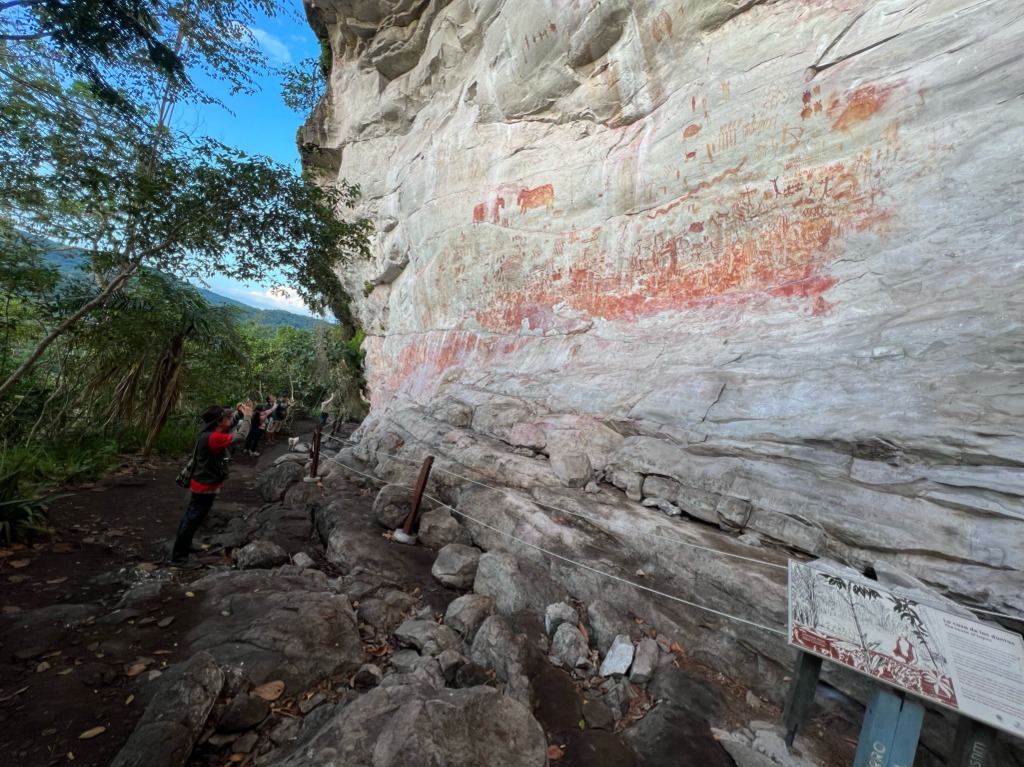
Deep in the Colombian Amazon, hundreds of rock panels bear the marks of ancient artists — paintings that have survived millennia beneath the shelter of towering tepuis. Using 3D LiDAR scanning and spectral imaging, we are documenting these irreplaceable sites so the world can study, explore, and help protect them. For the first time, you can examine these panels yourself — in full 3D, from anywhere in the world.
In the Colombian Amazon, hundreds of rock panels are covered in ancient paintings — a vast, open-air gallery created by cultures we are only beginning to understand. These painted surfaces are largely protected by the natural geometry of tepuis, flat-topped quartzite sandstone formations that are part of the ancient Guiana Shield — some of the hardest, most ancient rock on Earth — whose undercut walls shield the art from direct exposure to rain and sun. It is this geological accident that has allowed the paintings to survive for millennia.
But survival is not guaranteed. The clearing and burning of surrounding forests has sent fire and smoke directly into these sheltered overhangs, damaging and in some cases destroying panels entirely. Equally troubling, modern visitors sometimes leave graffiti — declarations of love, dates, initials — carved or painted directly over the ancient art, causing irreversible harm to surfaces that may be thousands of years old.
This is why our documentation work is so critically important. Every panel we scan becomes a permanent, high-resolution digital record — a safeguard against the ongoing threats of fire, vandalism, and neglect. These 3D models allow scientists, researchers, and the public to study the art in extraordinary detail, even if the originals are someday lost.

We are using 3D LiDAR technology to map, measure, and permanently record these archaeological sites so they can be studied and appreciated far into the future. LiDAR captures not only the geometry of the rock surfaces at sub-millimeter accuracy, but also enables powerful spectral analysis techniques that reveal details invisible to the naked eye.
For the first time ever, you can explore these sites from the comfort of home. No extreme travel costs, no foreign languages to navigate, no jungle hiking, no dangerous boat rides up fast-moving rivers, no oppressive heat, swarms of biting insects, or encounters with highly venomous snakes. Instead, it is just you and your computer or mobile device, examining these archaeological sites in full 3D — from your living room or even from Starbucks.
Our Xplorer tool takes this a step further. It allows you to analyze the panels using a variety of spectral enhancements, take precise measurements directly on the 3D models, and capture high-resolution screenshots for AI-based analysis. What patterns will you notice? What connections will you draw? Be sure to leave a comment and share your findings.
Decoding the Pigments
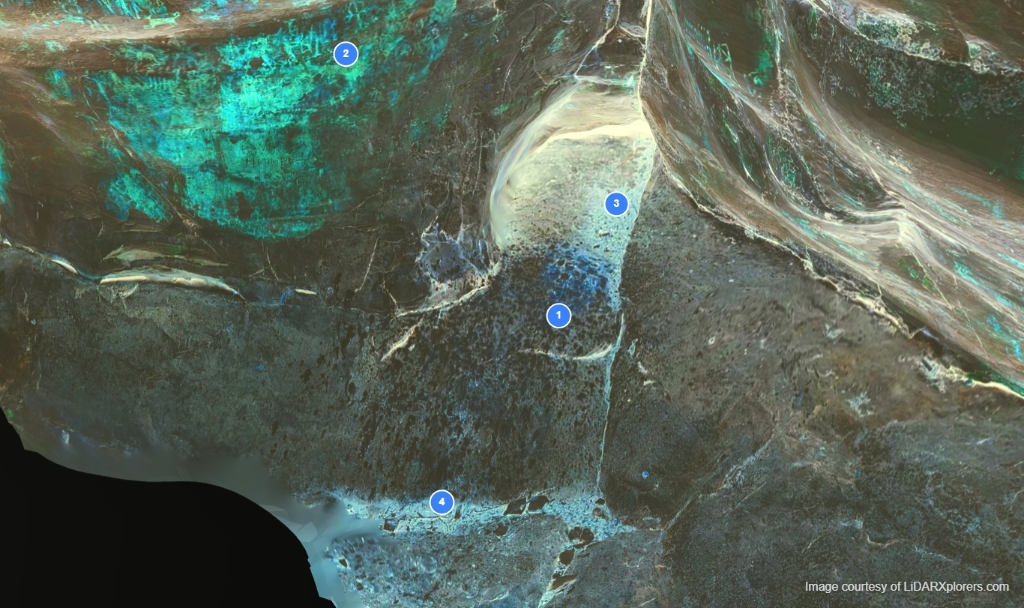
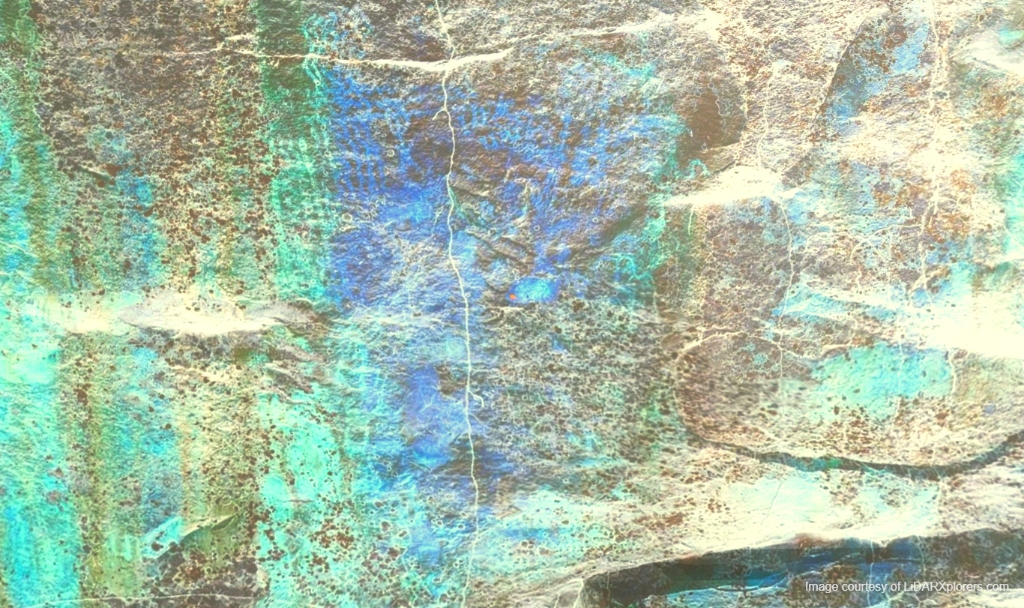
One of the most compelling aspects of this research is what spectral imaging reveals about the paints themselves. Under enhanced analysis, distinct pigment compositions become immediately apparent — differences that are subtle or invisible in natural light.
Consider the panel shown here. In the spectral view, marker #1 identifies a lighter red pigment, while markers #2 and #3 highlight areas of much darker, denser paint. These are not random variations; they represent fundamentally different pigment compositions that raise profound questions about how these paintings were created.

Were these different pigments mixed at the same time, or do they represent separate painting events separated by years, decades, or even centuries? Do the lighter and darker paints contain different mineral ingredients? Were they the work of the same artist perfecting a recipe over time, or the contributions of entirely different individuals or cultures? Are the darker paintings the same age as the lighter ones that surround them?
These are not idle questions. The answers could reshape our understanding of the cultural timeline in this region and reveal whether these sites were continuously used sacred spaces or revisited intermittently across generations. The tools to begin investigating are right here in this article.
Sierra de La Lindosa & Cerro Azul
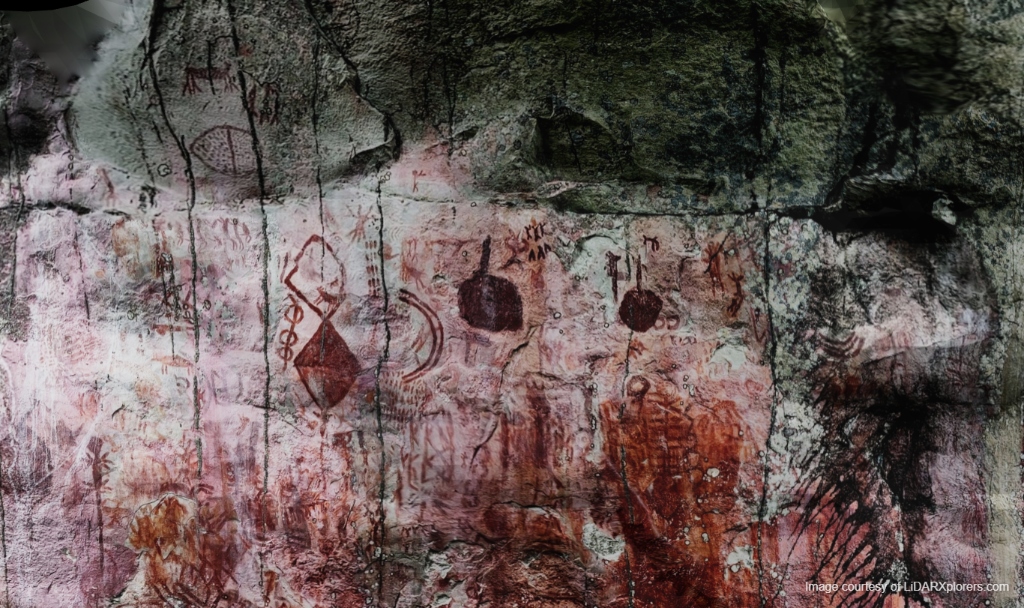
We begin our exploration at Sierra de La Lindosa and Cerro Azul, located in the department of Guaviare, Colombia. These sites lie deep within what is known as a Colombian "red zone" — remote areas historically controlled by armed guerrilla groups, making access extremely dangerous for outsiders. Recent peace agreements between these groups and the Colombian government have opened a narrow window for scientific work, but progress remains painstakingly slow.
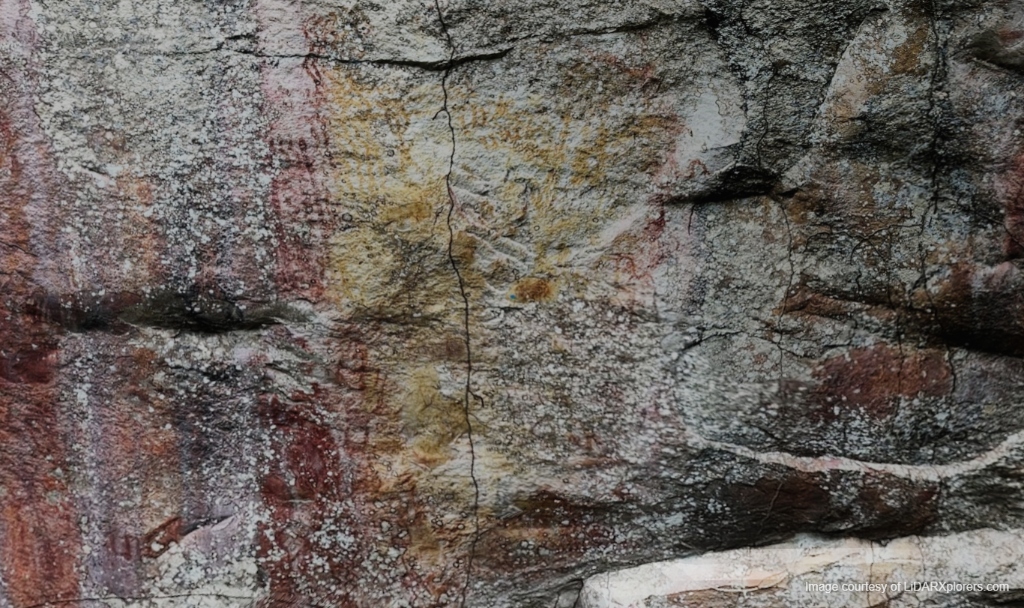
And yet, what has already been documented here is extraordinary. Among the most intriguing discoveries are panels where yellow and red paints appear side by side. In some areas, yellow pigments have been painted over with red, but in others — like the panel shown here — the yellow was left untouched.
This raises a cascade of questions. Was the yellow originally red paint that faded over time through exposure to ultraviolet light? Are the yellow pigments chemically different, perhaps more sensitive to environmental degradation? Or was yellow always a deliberate, distinct color choice — one that the later artists chose not to cover? The spectral data provides the first step toward answering these questions, and the 3D models below let you explore the evidence firsthand.
Sensational articles raging across social media claim that these paintings are 12,500 years old, while others describe a continuous mural stretching eight miles in length. These claims are based on the discovery of seeds, charcoal from ancient fires, and animal bones found in soil layers beneath the panels, as well as interpretations that some figures depict long-extinct megafauna such as giant ground sloths and mastodons. It is these ideas that fuel the viral headlines and the bold scientific theories currently surrounding these sites.
The reality, as always, is more complex. The pigments used in these paintings lack the carbon and organic elements required for direct radiocarbon dating. In other words, you cannot simply date the paint itself — at least not with current methods. However, as access improves and new techniques emerge — such as uranium-thorium dating of mineral deposits that may have formed over the painted surfaces — clearer answers may eventually come, provided such datable material can be found on these panels.
And this is where you come in. Right here in this article are several panels reproduced in full 3D for you to analyze. Perhaps you will notice a mineral crust forming over a painted figure — a potential dating opportunity that fieldwork has not yet identified. Perhaps you will spot patterns in the pigment layering that suggest a sequence of creation spanning centuries. It is important that we scan more, and it is equally important that more eyes examine what has already been scanned.
📏 A note on scale: None of these 3D models are eight miles long — no such continuous mural exists. Most painted panels are roughly the size of a modern house, and each one is packed with detail worth exploring.
🔭 Explore the Panels in 3D
Click any panel below to open it in the GLB Explorer — rotate, zoom, measure, and analyze with spectral enhancements.
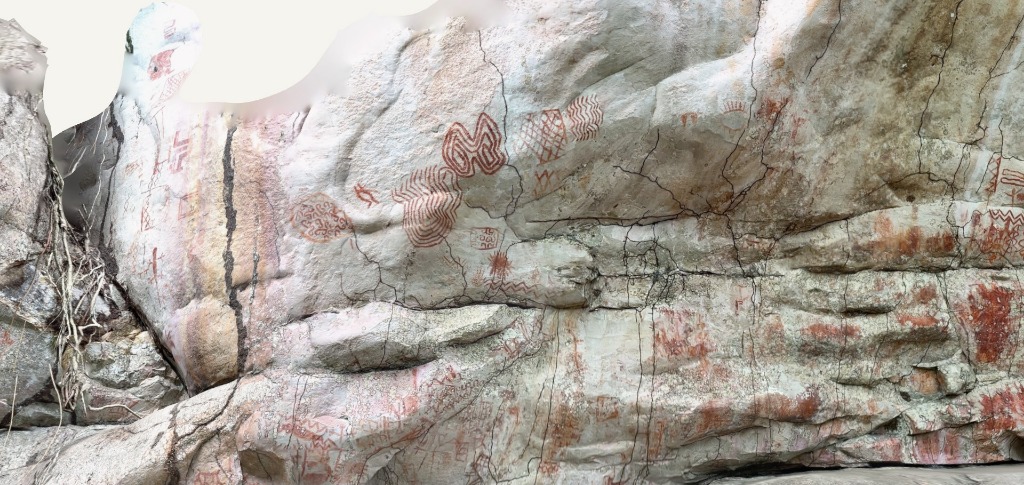
La Lindosa Panel — Sierra de La Lindosa
A richly painted surface beneath the towering tepui overhangs
Launch 3D Viewer →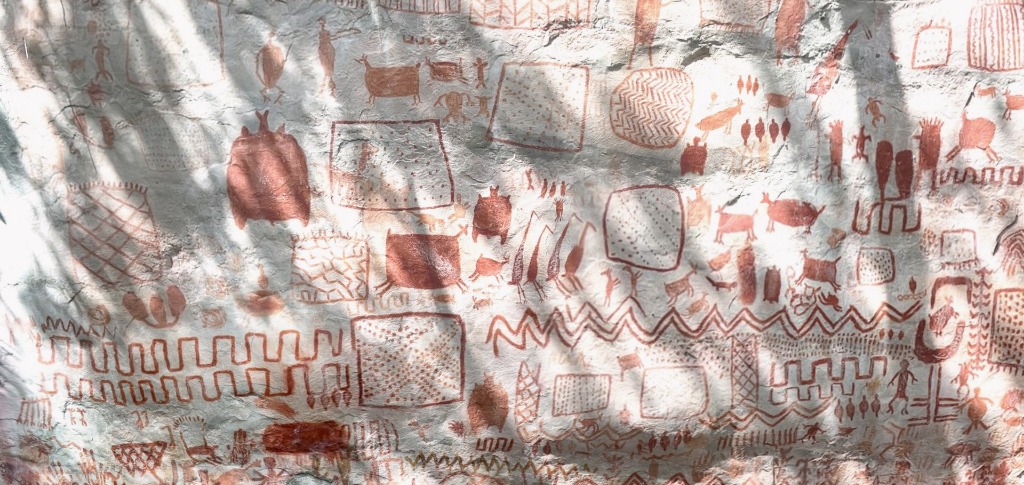
The Bat Panel — Cerro Azul (Panel 1)
Named for the bat figures among the densely layered paintings
Launch 3D Viewer →
Cerro Azul — Panel 2
Multiple pigment compositions visible under spectral analysis
Launch 3D Viewer →
Cerro Azul — Panel 3
Geometric patterns and figures spanning the full rock face
Launch 3D Viewer →🔍 What Will You Discover?
Use the 3D viewers and spectral analysis tools above to explore these ancient panels for yourself. You may notice details that no one has documented before — mineral deposits that could provide datable material, pigment patterns that reveal a construction timeline, or even faded figures hidden beneath later paintings.
Share your findings! Leave a comment below with your observations, screenshots, or questions.
Together, we can help document and protect these irreplaceable records of human history.